Thursday, 1 October 2015


Near the Windmill, Winchelsea
 
 
Bone hard the earth this autumn
rattle
of the wind through blown
thistles


balm
for burning grass
but not the long-awaited cold
rain


clatter
of the wings
of dragonflies


Sunday, 27 September 2015


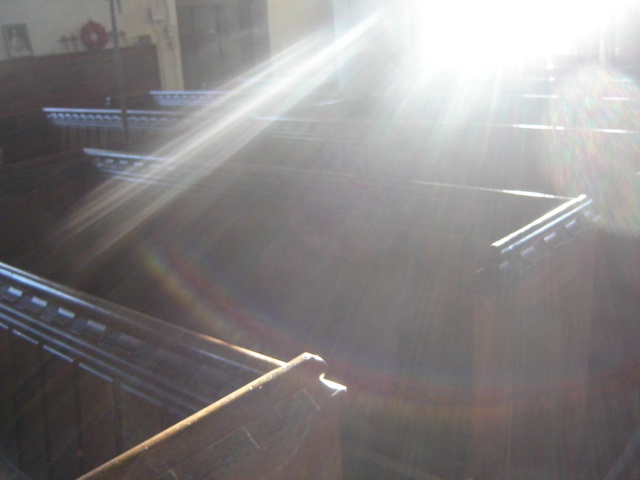
IN OLD ROMNEY CHURCH

The clock beats, leafy shadows wave
upon a sunlit wall; can all of human history be held
within one moment of a summer's afternoon?
The clock's beat
which bore our planet out of emptiness
will bear it back again - the clouds, the trees,
the birds chattering beyond the window-pane;
yet, growing older, time
is crossed and recrossed constantly with hints
of something else, imbued by every scent and texture
of this ancient place; experience
and dreams, and memories
and new experience attained through art
are more real to me now
than time and space
and shadows of reality we move among


Sunday, 5 July 2015


Memories of the Marlborough Downs


Sometimes in memory I see
those boundless skylines, hilltop woods and distant knots of trees
whose echoes linger on the sky,
a rutted road
receding over folding hills
beneath a baking sun.

And as the memory expands and breathes I see
an afternoon progressing through the hours of heat,
a golden haze upon the stippled corn, a silence counterpointed only
by the song of skylarks and the drone of bees
and all the creatures which abound
among the stalks.

Yet, reaching back, the memory grows weak
as I attempt to see the evening and the setting sun
bestow a ray of gold on every bush, on every leaf,
the haze dispersing - colours, textures, shapes of sun and shadow growing sharper,
more distinct. The dots of trees along the farthest ridge,
the flawless downs, the hilltop camps arranged in cosmic silence seem to gain
a power greater even than before and, for an instant, all of time
is held within a point of timelessness.

Yet memory alone cannot retain
what moved, so long ago, through head and heart and feet, I just recall,
as clouds process across the western sky,
a breath of hope.   


Washmore Hill, June


The wind moves
unhindered on these open, empty hills,
its ripples, tides and currents
echoed in the convolutions of the turning corn,
now deepest green is swept with silver grey
and warmer green with russet, russet gold
and gold with cream. The downs are swirling,
seething like the sea, awaiting harvest when the earth
is still


Sunday, 21 June 2015


The Curse of “Genre”


A scourge of the twenty-first century is the need for everything to be pigeon-holed. Political campaigners divide us up according to how we are likely to vote, advertisers break us down into socio-economic target groups the better to sell us their products, our three-year old children are tested to see whether they are more suited to careers in the arts or the sciences.

Nowhere is this more rife than in book publishing. Every author who has ever filled out a submission form to a publisher or agent will have encountered the question ‘Genre?’ Is your book a thriller? Is it a romance? Is it chick-lit? Is it historical? Is it sci-fi? Is it erotica? Or does it, by virtue of a reference to God, post-modernism or Jean-Paul Sartre, qualify for that all-embracing and meaningless label ‘literary’. Again, it’s all to do with pigeon-holing, or ‘product placement’ as it’s known in the trade. The publishing industry is about flogging books – nothing more. That’s how publishers and agents pay their mortgages.  Whatever breathless claims they make on their websites about being on the lookout for something ‘fresh and original’, the truth is that ‘fresh and original’ is the last thing they want unless it’s freshness and originality that can be fitted neatly into an established and marketable genre. Genuine freshness and originality – something which breaks a few boundaries and takes us out of our comfort zone – is a market uncertainty and to be avoided at all costs.

This trend is understandable in a world where marketing of every kind has become so aggressive and competitive but it is nonetheless destructive and frustrating for authors. Genuinely talented writers want to write about real life in all its breadth and glory but real life is too big, too vital, too organic and too unpredictable to be squeezed into the straightjacket of a ‘genre’. So many authors must stare at that question in the submissions form and wonder what the hell to put.  Okay, there’s a romance but it’s not really a romantic novel; there are some intense and beautifully handled love-scenes but anyone expecting ‘erotica’ (i.e. graphic and perverted pornography which the term has sadly come to denote) is going to be disappointed. There are some tantalizingly unanswered questions to entice the reader on but it’s not really a ‘thriller’ in the conventional sense or even a ‘mystery’.  And there are some deliciously funny scenes but to call it a ‘comedy’ would be to give the wrong impression entirely. So in the end they just shrug hopelessly and put ‘literary’, knowing they are probably signing their novel’s death warrant.  

I believe this trend, in a more subtle way, is equally destructive to readers. Possibly without realising it, they have had their expectations conditioned and channelled by the hype. They’ve been told a novel is a rom-com so they expect to laugh their socks off and maybe have a little weep. They’ve been told it’s a thriller so they expect to be thrilled, and so on. That twenty-something settling down on her sun lounger to her lovely chunk of chick lit is going to be annoyed to encounter the mysterious disappearance of one of the characters or the hint of some nefarious plot at the heart of government. Yet, if her expectations had not been quite so narrowly channelled, she might have been receptive to these developments and been intrigued.

I’m not suggesting for a moment that a novel shouldn’t have an aesthetic unity – an integral structure and ‘skin.’ There is nothing more annoying than a novel that starts as one thing then turns into another. But that is more to do with the craft of writing. Some authors can blend and weave romance, eroticism, humour and suspense to create a satisfying whole, while others succeed only in producing a jangling, dissatisfying jumble which isn’t anything of anything. Besides, readers soon come to know which authors they can trust to satisfy and sometimes challenge them, so genre becomes of secondary importance.

The absurdity of the situation is highlighted by considering the great authors of the past. How on earth would you fit them into ‘genres’? Would Jane Austen’s novels have been 'chick-lit' and Joseph Conrad’s 'thrillers'? Would F. Scott Fitzgerald have been ‘lit-lite’ because his characters were all rather pretty, wore fashionable clothes and knew how to pop a champagne cork? How would you label ‘The Old Man and the Sea’? A tense psychological thriller about fishing? And what about Dickens or George Eliot or the Brontes or John Steinbeck or Hardy or Tolstoy? Of course, it can be argued that The Big Man Himself had to arrange his plays into genres so that his audiences and royal patrons knew what they were in for.  Yet the categories of ‘comedy’, ‘tragedy’, ‘history play’ etc. are largely labels which have been added later by academics and people writing exam syllabi for in reality every one of Shakespeare’s plays spills over its category like leavened dough over the sides of a baking tin. Think of the moments of comic absurdity in ‘King Lear’ for example – the ultimate tragedy – or the dark and poignant undertones in ‘A Midsummer Night’s Dream’ – the ultimate romantic comedy.

This problem is neatly avoided, of course, by lumping everything written before about 1920 under the massive and meaningless heading of ‘Classic’ – just as they are labelled in the bowels of Waterstones – their black spines offered by the thousand to the lone grizzled, bespectacled buyer like me or the schoolgirl searching for her ‘set text’ – as far as possible from the latest biography of David Beckham or the most recent rearrangement of preposterous sex scenes by the prodigious Mrs James proudly propped in the entrance to lure passers-by. Perhaps that’s a thought to offer a shred of hope to unpublished authors in their plight: if they can somehow make it through the cultural desert of the 21st century, they might reach a point where they can put in the 'Genre' field of the publishers' submission form: 'Classic'. Though they'll probably need to have been dead for a hundred years.


Monday, 15 June 2015


Midsummer Night


Windows wide upon the whirring world

the curtain stirs

between the shadow-mouths of furniture

and shifting trees, between the brink of sleep

and forest-realms of badgers, foxes, owls;

the lapsing, rising breeze

deflects the nightjar, holds

one blackbird calling

in the dark wood; is the moon

vast, round, bronze beyond the maybug's

fumbling, the line of distant downs

still visible from Great Oaks Wood?


Vagabundos (from 'Songs of Andalusia')

Dos Gitanos - hombre y esposa
dos personas de piel morena
piel quemada en el sol del sur
endurecida por los vientos y arenas
del camino

Dos personas, vagabundos
líneas de su historia escritas en su rostro
expulsados de tierra a tierra
pobreza a pobreza
aferrando todavía, después de todos sus viajes
al espíritu, espíritu de su pueblo
capturado en la música flamenca
en canciones, gritos locos y salvajes
de dolor, humiliación y sufrimiento
espíritu gitano aún en las cadencies
de la guitarra


This is a rough translation - not intended as a poem in its own right.

Two Gypsies - man and wife
two dark-skinned people,
skin burned by the southern sun
hardened by the winds and sand
of the open road.

Two people - vagabonds
the lines of their history written in their faces
driven from one land to another
from poverty to poverty,
clinging still, after all their journeys
to their spirit, the spirit of their people
captured in the Flamenco music
in songs, in wild, savage cries
of pain, humiliation, suffering,
the gypsy spirit, even in the cadences
of the guitar.

 

Saturday, 13 June 2015


Midsummer Night at Tynepits Cottage

Curtains stir
     against the bright west
          a moth purrs

Sunday, 31 May 2015


Sudden Summer


hogweed

grass

nettles

thistles

suddenly are waist high,

a tiny path

winds down where once were open fields

to a wild wood,

heat and drifting seed

have changed the earth,

cardinal and cinnabar

dissemble thistle flowers,

pools of shade

where bullocks crowd,

kick and flick at flies.

strands of flesh now black on white bones

within the throbbing sky